PIR Motion Sensor + Buzzer
Detect movement with an HC‑SR501 and sound a buzzer — using a non‑blocking millis() timer.
⬇ Download the sketch
Save
Project_4_ESP32_PIR_Motion_Sensor.ino, then open it in the Arduino IDE (setup: Project 0b).
1 · How the PIR sensor works
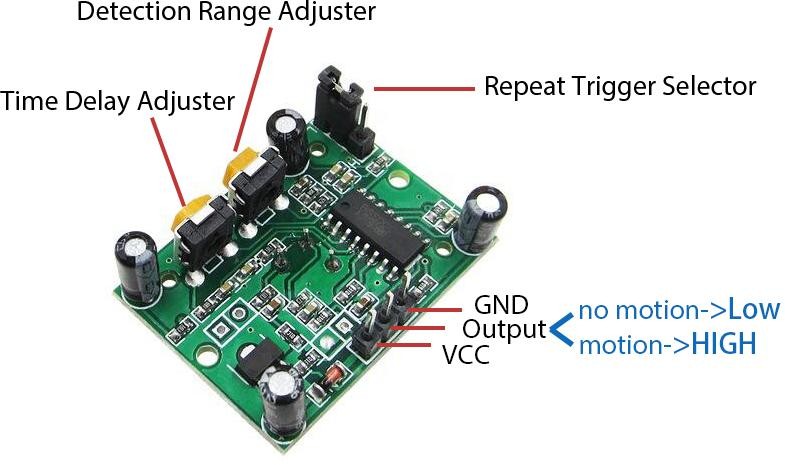
- A PIR senses the infra‑red heat of living bodies and triggers on change — a warm, moving object.
- OUT = HIGH on motion, LOW otherwise.
- A person standing perfectly still may not be detected; a moving heat‑less object (robot, car) isn't either.
Warm‑up: after power‑on the PIR needs ~30–60 s to stabilize before it reads reliably.
2 · Non‑blocking timing: delay() vs millis()
delay(3000) freezes the whole program for 3 s. Instead we record when motion last happened and check elapsed time — keeping the loop responsive:
lastMotionTime = millis();                    // remember "now"
if (millis() - lastMotionTime >= holdTime) {  // has enough time passed?
  ...
}
This pattern scales to programs doing many things at once — a habit worth building early.
3 · Parts
| Qty | Part | Notes |
|---|---|---|
| 1 | ESP32 · breadboard · jumper wires | — |
| 1 | HC‑SR501 PIR | Powered from 5 V |
| 1 | Active buzzer | Beeps on its own when powered |
4 · Wiring
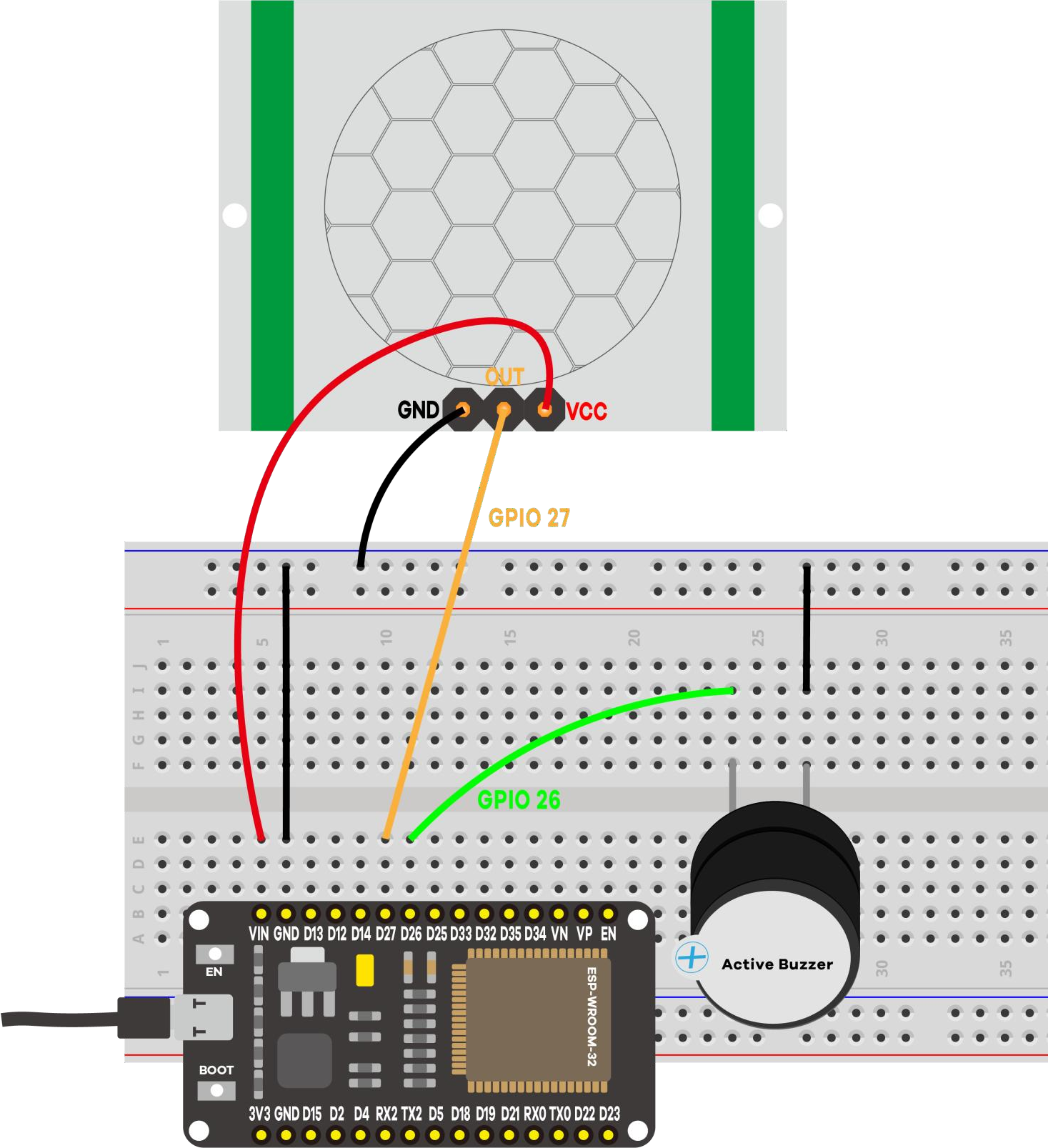
| From | To |
|---|---|
| PIR VCC | VIN (5 V) |
| PIR GND | GND |
| PIR OUT | GPIO 27 |
| Buzzer + | GPIO 26 |
| Buzzer − | GND |
Why VIN, not 3V3? The HC‑SR501 needs 5 V (on
VIN when USB‑powered). Its OUT signal is still ESP32‑safe.5 · Code & expected serial output
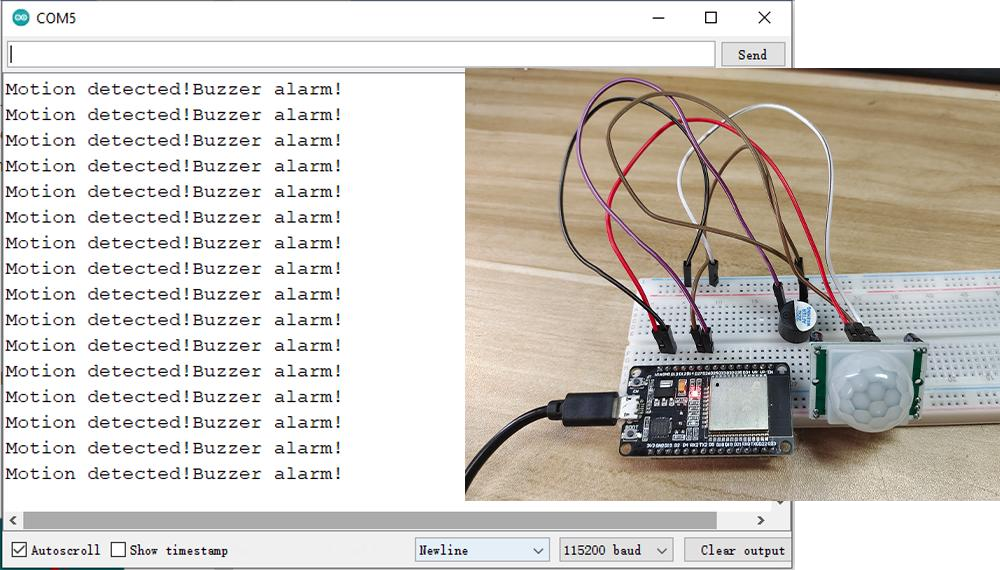
The buzzer turns on when motion starts and off after ~3 s with no motion. Logging is event‑based — one line on, one line off. Open Serial Monitor at 115200:
==============================================
 Project 4: ESP32 PIR Motion Sensor + Buzzer
==============================================
PIR OUT -> GPIO 27
Buzzer  -> GPIO 26
Buzzer holds ON for 3000 ms after motion stops.
NOTE: the PIR needs ~30-60 s to warm up after power-on.
----------------------------------------------
[EVENT] MOTION detected  -> buzzer ON
[EVENT] No motion (hold elapsed) -> buzzer OFF
Improved from the original sketch: the kit's version re‑printed the same message every loop and had a confusing "stop alarm" line. This one logs only the two real events.
6 · Demonstration
7 · Troubleshooting
| Symptom | Likely cause | Fix |
|---|---|---|
| Always triggers | Warming up / sensitivity too high | Wait 60 s; lower the sensitivity trimmer |
| Never triggers | PIR on 3.3 V, or OUT mis‑wired | Power VCC from VIN (5 V); OUT → GPIO 27 |
| Buzzer silent | Reversed / wrong pin | + → GPIO 26, − → GND |
| Buzzer never stops | Constant motion / retrigger jumper | Hold still; check the jumper |
| Monitor blank | Wrong baud | Set it to 115200 |